

Most Enterprise teams we talk to are not actually stuck on whether “genAI” can do the task. They’ve already proven that it can. Somebody on the team made something genuinely good, showed it around the studio, and everybody in the room got really excited about the possibilities!
But then momentum stalls. The prototype lives on one person’s machine and it’s hard to scale. It can’t take the brand’s real assets, can’t run a hundred versions in the wild, it's not exactly production ready. The distance between “we proved it” and “it’s in the pipeline” turns out to be the entire job!
If that sounds familiar, then let me introduce you to the new Forward Deployed Creative offering, because this is how Comfy is helping you close that gap. A Comfy expert embeds with your team, builds the workflows inside your environment, and helps your people take ownership of them.
How a FDCT engagement runs
Validate. First we prove the outcome is achievable using your own work, your own products, your own brand constraints. Sometimes during this discovery phase the honest answer we arrive at is “well you can’t do that yet, and here’s specifically what’s missing.” But that answer is worth getting early instead of spending weeks spinning your wheels in production.
Build. If the idea is validated, then next we move inside your Comfy Enterprise environment, working with your models and your assets, in a iterative process where we hone in on the Comfy workflow of your production dreams!
Enable. FDCTs develop and host bespoke training with your team to get them on their feet and self-sufficient, which we measure by whether they can change the workflows, not whether they can just click “run” it.
Own. Lastly, and this is the fun part, the workflow(s) are delivered and they’re yours! The direct FDCT line stays open under your enterprise agreement of course, but the goal is that you don’t need to use it often unless the next big idea comes up.
This is the difference between creating a workflow that ships once and creating one that’s still in use next quarter across dozens, or hundreds, of production cycles.
Enablement is the deliverable, not a nice-to-have
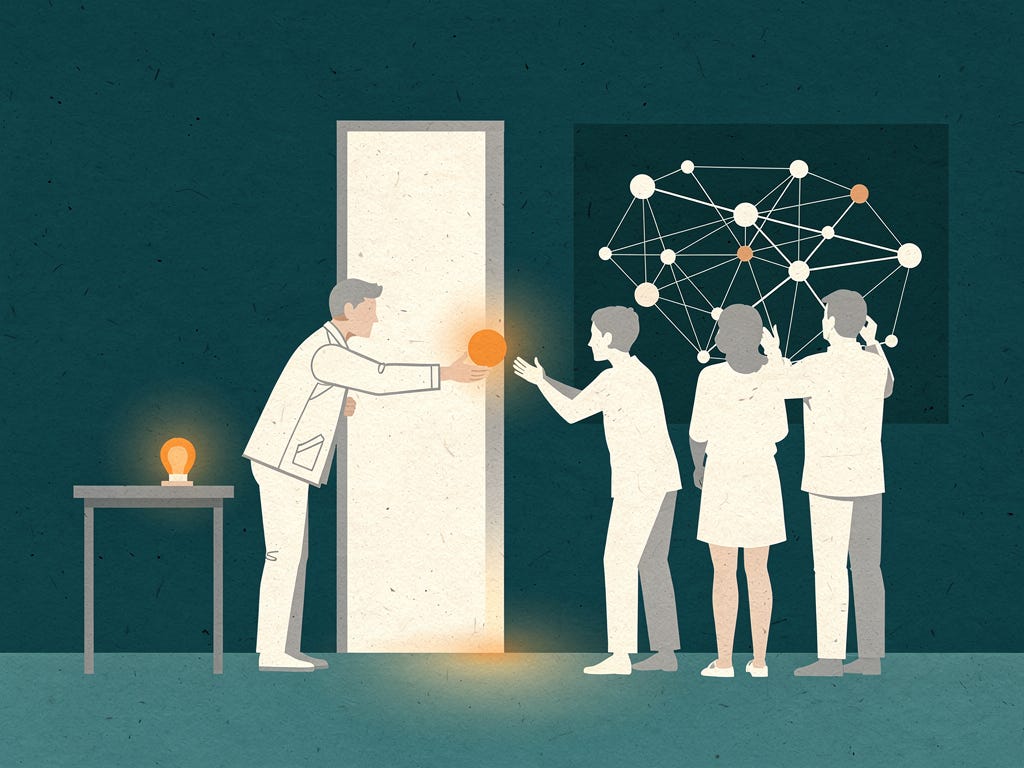
In my years as a VFX artist, I’ve watched plenty of good tools die in production. Not because they didn’t work, but because the few people who understood them rolled off the show, leaving behind a workflow no one else knew how to use.
AI hasn’t changed that. If a workflow becomes a black box, teams eventually abandon it and go back to what they know.
That experience shapes the teaching sensibility we bring to every engagement:
Build it in front of them, not for them. A workflow that simply appears, finished, is a workflow nobody feels ownership of and doesn’t help anyone. If your team watches it get assembled, they know where the bodies are buried.
Name things like a production artist. Node titles, group labels, reroutes. The graph should read like a sentence six months from now, to someone who wasn’t in the room.
Leave the seams visible. Resist collapsing everything into one clever node just to hide the wires. The obvious version an artist can edit quickly beats the elegant version they’re afraid to touch.
Teach the failure, not just the happy path. Anyone can demo the good render. Real enablement is showing what it looks like when the mask slips, the seed drifts, or the model runs out of VRAM…and what to do about it.
The talent bench
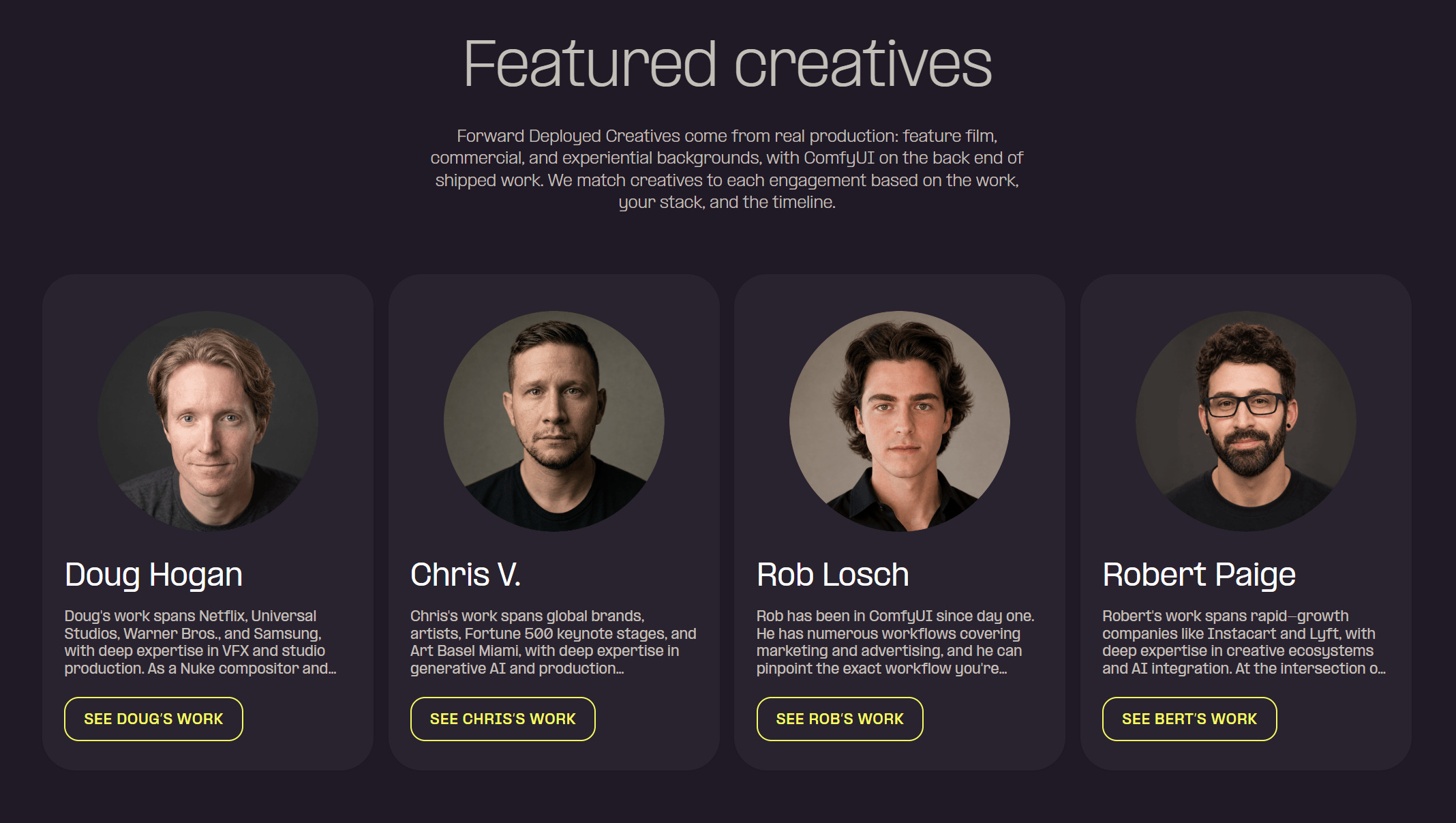
Forward Deployed Creatives come from the real production world, and we are matched to the creative required for the Enterprise engagement based on the type of work, the tech stack, and the timeline. So let me introduce you to your FDC team!
Chris V.
Sits between artist and engineer. He’s worked with global brands, walked Fortune 500 keynote stages, and architected custom VFX and AI pipelines. He’s the one you want when the pipeline question and the aesthetic question are the same question.
Rob Losch
Has been in ComfyUI since day one, with a deep library across marketing and advertising. Describe what you’re trying to make and he can point at the exact graph.
Robert Paige
Came up through rapid-growth companies like Instacart and Lyft, building production infrastructure for creative organizations. He lives in the systems layer that makes a good idea survive contact with an org chart.
Doug Hogan
That’s me! I’m come from the world of VFX and studio production. That’s Nuke compositing, Python tooling, and feature and episodic work across Netflix, Universal, Warner Bros., and Samsung. I love solving both creative and technical problems to produce rock solid production pipelines.
The best ones are the ones you never knew were there
Speaking from a personal perspective for a moment, coming from the world of VFX, there’s a line every artist repeats like a mantra: “the best visual effects are the ones you never noticed.” Not the creature or the collapsing building. It’s the removed rig, the extended set, the sky that was never there. If the audience walks out talking about the effects, somebody upstream had a rough day!
I’ve come to think about Forward Deployed Creative work the same way.
The measure of a good Enterprise engagement isn’t how much of us is left in the finished workflow or how much you need us to run it. It’s how little.
Six months on, the graph has your team’s naming conventions on it, three nodes we never wrote, and a stage we would have argued about. Somebody who joined after we left uses it every week and has no idea it started as a proof of concept with an outside name attached.
That’s the whole goal. Validate it. Build it. Teach it. Then let it become theirs.
So if your team has a creative problem it has already half-solved but can’t get into production, that’s exactly the conversation we’re excited to have with the new Forward Deployed Creative program here at Comfy.